Canada’s Enduring Destiny
No Breakup, No Takeover, Just More Hockey Trash-Talk

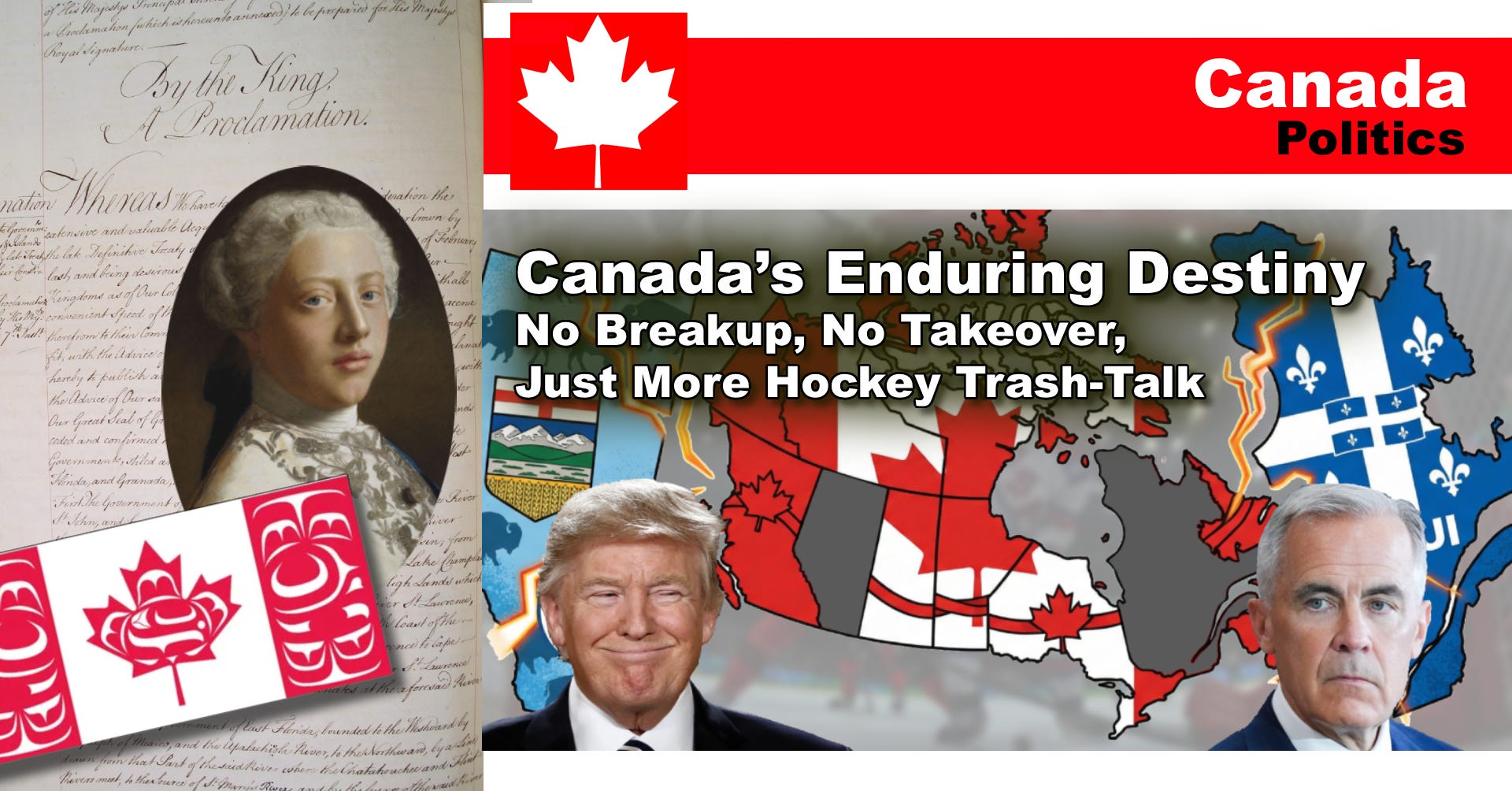
During the recent Milano Cortina 2026 Winter Olympic, the U.S. claimed gold in both men’s and women’s hockey, but Canada held its own in curling with a men’s gold and women’s bronze. It’s a reminder that the timeless Canada–U.S. rivalry endures, fierce on the ice but rooted in mutual respect. They are, after all, the best of neighbors: sharing the longest undefended border in the world and no shortage of goodwill. When national pride is on the line, each country relishes outshining the other. Annexation? That would never fly, if only because it would kill the thrill of those epic matchups. Who else are they going to beat for gold?
Jokes aside, the latest wave of doomsday chatter about Canada’s potential demise, whether from internal splits or external takeover, is recycled hysteria. In 2026, these old fears are resurfacing like clockwork, amplified by political theater and economic jabs. Alberta separatists are gathering signatures to force an independence question onto the October 19 referendum ballot. Quebec’s Parti Québécois is riding high in polls with sovereignty talk ahead of the fall election. And Trump’s “51st state” quips keep the annexation-worriers up at night. These movements draw on legitimate frustrations, including federal overreach on energy policy, trade tensions, and regional identity, but the end result is a lot of noise about scenarios that history, law, economics, and sheer practicality render all but impossible.
The Internal Threat: Provincial Separatism
Separatist movements thrive on real grievances. In Alberta, the frustrations center on Ottawa’s grip over energy and immigration policy. In Quebec, they revolve around cultural preservation and the enduring question of national identity. These are legitimate concerns, but frustration is not a plan, and a plan is not a viable one just because the frustration behind it is genuine.
Start with the leaders themselves. Alberta Premier Danielle Smith, whose government is behind the October 19 referendum, has been unambiguous: she supports a “sovereign Alberta within a united Canada” and has not signed any petition pushing for outright independence. Her goal, she’s said repeatedly, is to prove that Canada can work for Alberta, not to break it apart. The referendum is about constitutional reform, not separation. Even University of Calgary political scientist Barry Cooper, a vocal proponent of the Alberta Sovereignty Act, acknowledges that Smith has “never really advocated for separation.”
In Quebec, the Parti Québécois leads the polls ahead of the October 5 provincial election and has promised a sovereignty referendum by 2030 if elected. But leading a provincial election and actually winning a sovereignty vote are very different things. Public support for separation in Quebec sits in the low-to-mid thirties at best, and crucially, that number collapses when people are asked to consider the real costs. Ipsos found that initial support of around 31% dropped to 15–16% once respondents were walked through the economic consequences. That’s not a movement; that’s a protest.
The national picture is even clearer. Alberta’s numbers tell a similar story: headline support hovers around 29–34% depending on the poll, but committed separatists, those who stay on board after confronting what independence would actually mean, represent only about 15% of Albertans. A February 2026 Angus Reid survey found that 79% of Canadians across the country would want to block Alberta from leaving if they could, and 71% would say the same about Quebec. No province has seceded since Confederation in 1867. Quebec’s referendums failed in 1980 and again in 1995, the second time by less than a percentage point. Alberta’s “Wexit” momentum flared and fizzled after 2019. The pattern is consistent.
It would be a mistake, though, to treat the federal government as a passive bystander above reproach. Prime Minister Mark Carney’s government has pledged to accelerate energy infrastructure approvals and has opened dialogue on the fiscal arrangements that have long rankled Alberta. Quebec has seen renewed federal investment in French-language programming and formal recognition of its distinct cultural status. But critics across the spectrum, including Conservative voices like former Alberta MP Shannon Stubbs, argue these are gestures, not structural fixes. The frustrations are real, and Ottawa bears genuine responsibility for how seriously it addresses them. Acknowledging that the federal government has room to improve is simply honest. It just doesn’t make separation the answer.
Legally, separation faces barriers that go well beyond public opinion. The Supreme Court’s 1998 Secession Reference and the Clarity Act together require a clear majority on a clear question, followed by negotiations involving Ottawa and every province. There are no shortcuts, and unilateral declarations carry no legal weight. Beyond that, Canada’s constitutional monarchy adds another layer of complexity: King Charles III is Canada’s head of state, and any separation would require addressing the roles of the Governor General and lieutenant governors in constitutional amendments, which themselves require unanimous provincial consent under the Constitution Act of 1982. As constitutional expert Emmett Macfarlane puts it, “the Crown’s role in Canadian federalism makes unilateral separation virtually impossible.”
Then there are the treaties. Treaties 6, 7, and 8 in Alberta, along with overlapping agreements in Quebec, were signed with the Crown rather than the provinces, predating Alberta’s very creation in 1905. Grand Chief Trevor Mercredi of Treaty 8 First Nations has called separation a “treaty violation,” arguing that provinces have no authority to alter these agreements unilaterally. Chief Billy-Joe Tuccaro of Mikisew Cree First Nation is blunter still: “These treaties were never ‘land surrender’ instruments; they are agreements to share the land.” University of Alberta professor Matthew Wildcat frames it plainly: “Indigenous Peoples are not subjects of Alberta; they are partners.”
It’s worth pausing here, though, to note that Indigenous voices don’t belong in this conversation only as an obstacle to separatist ambitions. Many First Nations communities carry deep grievances with the existing federal structure, from chronic underfunding of on-reserve services to overrepresentation in the justice system to the slow crawl of land claims resolution. The Assembly of First Nations has consistently called for a nation-to-nation relationship grounded in Indigenous sovereignty, a framework that fits neither the status quo nor provincial separation. Whatever Canada’s future holds, Indigenous Peoples are rights-holders with their own claims to self-determination, not just stakeholders in someone else’s constitutional argument.
Fiscally, the case against separation is overwhelming. An independent Alberta would face immediate trade barriers on oil and gas, since roughly 80% of its exports flow through Canadian markets. Economist Trevor Tombe estimates the province’s own GDP would shrink by 4 to 6 percent, translating to $20–30 billion in annual losses. The debt picture is equally grim: Alberta would inherit a share of the federal debt on top of its provincial obligations, pushing total liabilities past $600 billion according to the Edmonton Chamber of Commerce. A 2025 study by Lennie Kaplan puts the lost economic activity over the following decade at $130 billion for Alberta. Compounding all of this, polling consistently shows that a large majority of Albertans who oppose separation would leave the province if it happened, a brain drain that would crater the tax base faster than any tariff.
Quebec’s math is no better. Economists estimate an independent Quebec would absorb a GDP hit of 5 to 10 percent of its own economy, with debt levels spiking sharply as federal equalization payments disappear and borrowing costs rise. Fraser Institute economist Patrick Grady has projected debt-to-GDP climbing to around 92%, and a 2025 Tolerance.ca analysis estimated total debt for an independent Quebec at $397 billion. Nearly half of Quebec’s jobs are tied to trade with the rest of the country, and the post-1995 near-miss referendum spooked investors badly enough to cost Quebec years of economic underperformance. Independence would repeat that, only without the safety net of still being Canada. Support for separation softens dramatically once people are confronted with these numbers, which is why the hardcore constituency never grows beyond a fraction of the population. This is protest politics, not a governing vision.
The External Threat: U.S. Annexation
Trump’s tariff volleys and “51st state” taunts have rattled Canadians: about 80% say they’re anxious about the relationship, and roughly a third fear some form of direct intervention. Alberta separatists cozying up to Trump officials hasn’t helped the mood. But strip away the bluster, and what’s actually happening is a pressure campaign on trade terms, border security, defense spending, and Arctic claims. Not a prelude to invasion.
The more honest version of American influence over Canada doesn’t require troops or a flag change. It’s quieter than that. American cultural exports dominate Canadian media, U.S. trade policy shapes Canadian industrial decisions, and Canadian governments of every political stripe have always had to calibrate their domestic choices with one eye on Washington. The Canada/U.S./Mexico Agreement, known as USMCA in the United States and CUSMA in Canada, touches energy pricing and even healthcare funding debates, all carrying the fingerprints of economic interdependence. This soft power dynamic is real and enduring, worth naming honestly not as a threat to sovereignty but as the actual nature of the relationship. It’s the ongoing negotiation of independence within deep integration. Formal annexation would be a catastrophe. What already exists is simply the reality of geography.
As for the formal annexation fantasy, the numbers don’t support it from the American side either. YouGov polling shows only 5% of Americans favor military annexation, with 62% opposed, and a January 2026 Research Co. survey found just 17% of Americans supporting Canada becoming a U.S. state or territory. But the more telling obstacle is political arithmetic. Absorbing nearly 40 million Canadians, most of whom lean considerably left of the American median, would be electoral poison for the Republican Party. New Senate seats from Canadian provinces would almost certainly flip the chamber blue, and hundreds of new House seats from a population that broadly supports universal healthcare and stricter gun laws would clash hard with GOP priorities. As UBC political scientist Max Cameron put it, the annexation idea is simply “preposterous,” and “the best guarantee Canada will never join the U.S. is Trump himself.” Congress would never vote for its own political realignment.
It’s also worth being clear that opposing annexation isn’t a left-wing position in Canada. Conservative Party leader Pierre Poilievre has been unequivocal: Canada is “not for sale.” Former Prime Minister Stephen Harper has criticized Trump’s rhetoric as counterproductive and reaffirmed his commitment to Canadian sovereignty. The Manning Centre and the Fraser Institute have both argued consistently that Canadian independence and economic strength go hand in hand. On this particular question, the country is genuinely united across partisan lines.
The structural incompatibilities between the two countries make annexation even more absurd on closer inspection. Canada’s parliamentary system, where the prime minister is accountable to Parliament and can be removed by a no-confidence vote, is fundamentally different from the American presidential model. Annexation would mean dismantling provincial legislatures, eliminating no-confidence mechanisms, and forcing over 150 years of governance architecture through a complete overhaul. The policy gaps run just as deep. Canada has publicly funded universal healthcare; the U.S. runs a private and employer-based system that still leaves tens of millions uninsured. Canada has strict gun laws; the U.S. has Second Amendment protections in a country with more than three times Canada’s gun density. Canada has a national carbon price; the U.S. has deeply partisan climate politics. These aren’t minor differences. They represent incompatible national identities.
Legally and internationally, annexation is simply forbidden. It would violate Article 2(4) of the UN Charter, which prohibits the use of force against another state’s territorial integrity, and the global fallout of condemnation, sanctions, and expulsion from international bodies would be swift and severe. More immediately, the U.S. and Canada are NATO allies, which means a move against Canada would shatter that alliance and potentially unravel the post-WWII security order that the United States itself built. Quinnipiac law professor Wayne Unger has called Trump’s economic coercion framing “as insulting as it is deeply flawed,” and that’s before getting to the military dimension, which carries no serious support anywhere.
There’s nowhere this tension is more pointed than the Arctic. Canada considers the Northwest Passage its internal waters, while the United States insists it’s an international strait. As Arctic ice retreats and new shipping routes open up, and as Russia and China pour resources into High North infrastructure, that disagreement is becoming less theoretical. Canada has responded with increased Arctic patrol deployments, expanded NORAD capabilities, and a stronger sovereignty posture in the region. The Arctic isn’t just a punchline to Trump’s annexation jokes; it’s one of the genuine strategic interests behind American pressure on Ottawa. A strong, independent Canada is the only credible way to hold those claims.
For all the noise, the window for any of this to unfold is vanishingly small. Trump faces the 22nd Amendment’s hard ceiling, since no president may be elected more than twice, and repealing it would require two-thirds of Congress and ratification by 38 states. Hamline University’s David Schultz is blunt: “Trump may not want to rule out a third term, but the 22nd Amendment does.” Three years from now, he’s gone. The scenario collapses under its own implausibility.
Why Canada Endures
Canada’s foundations are considerably tougher than the drama suggests. The country’s economy is bound to the United States through $2.5 trillion in annual bilateral trade. Its legal architecture, the Clarity Act, the Constitution, and the courts, ensures that any real constitutional change would be deliberate and negotiated, not chaotic. History has absorbed worse without fracture: Canada declined to join the American Revolution, repelled U.S. invasions in 1812, and survived two near-miss sovereignty referendums. It has never lost a province.
None of that means the grievances driving these conversations should be dismissed. Tariff fallout, regional alienation, pipeline politics, the slow work of Indigenous reconciliation, Arctic sovereignty: these are real challenges that deserve serious federal attention, not management by press release. Ottawa must earn the unity it asks Canadians to take for granted. The frustrations in Alberta and Quebec are legitimate, even if separation isn’t. That distinction matters.
But breakup or annexation? Those aren’t answers. They’re distractions, loud, cyclical, and ultimately hollow. Canada is built to bend, not shatter. Every wave of doomsday chatter has eventually receded, and this one will too.
Canada is, by any measure, a remarkable country, forged from diverse peoples and contributing peacekeeping, multiculturalism, and hard-won innovation to the world. From the discovery of insulin to cutting-edge work in quantum computing, it has consistently punched above its weight. At 159 years old, it’s still a young country with enormous room to grow. Its strength lies in unity, and that unity, backed by law, economic logic, and the stubborn will of the people, isn’t going anywhere.
As a dual-citizen who’s watched both sides of this border for years, the periodic freakouts feel like exactly what they are: classic overreaction. Canada is annoyingly stable, and that’s something worth appreciating. Time to ease up on the doom-scrolling and get back to the actual issues. After all, someone has to keep that rivalry alive. Who else is going to give us someone to trash-talk over hockey gold? Let’s keep the border banter going, eh? 😎